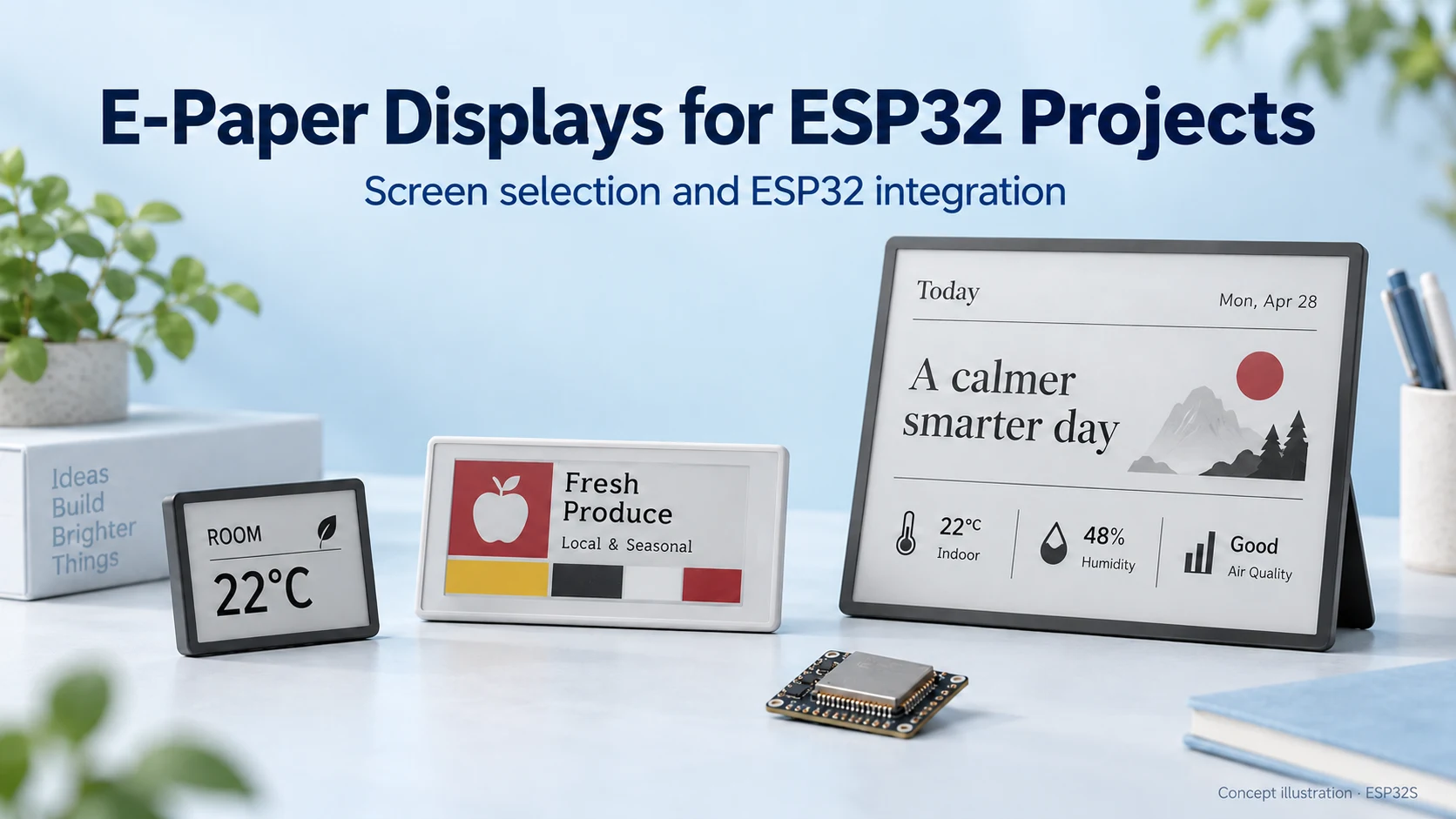
E-Paper Displays for ESP32: How to Choose the Right Screen
Choose an e-paper display for your ESP32 project: compare screen types, raw panels and modules, refresh modes, memory needs and power considerations.
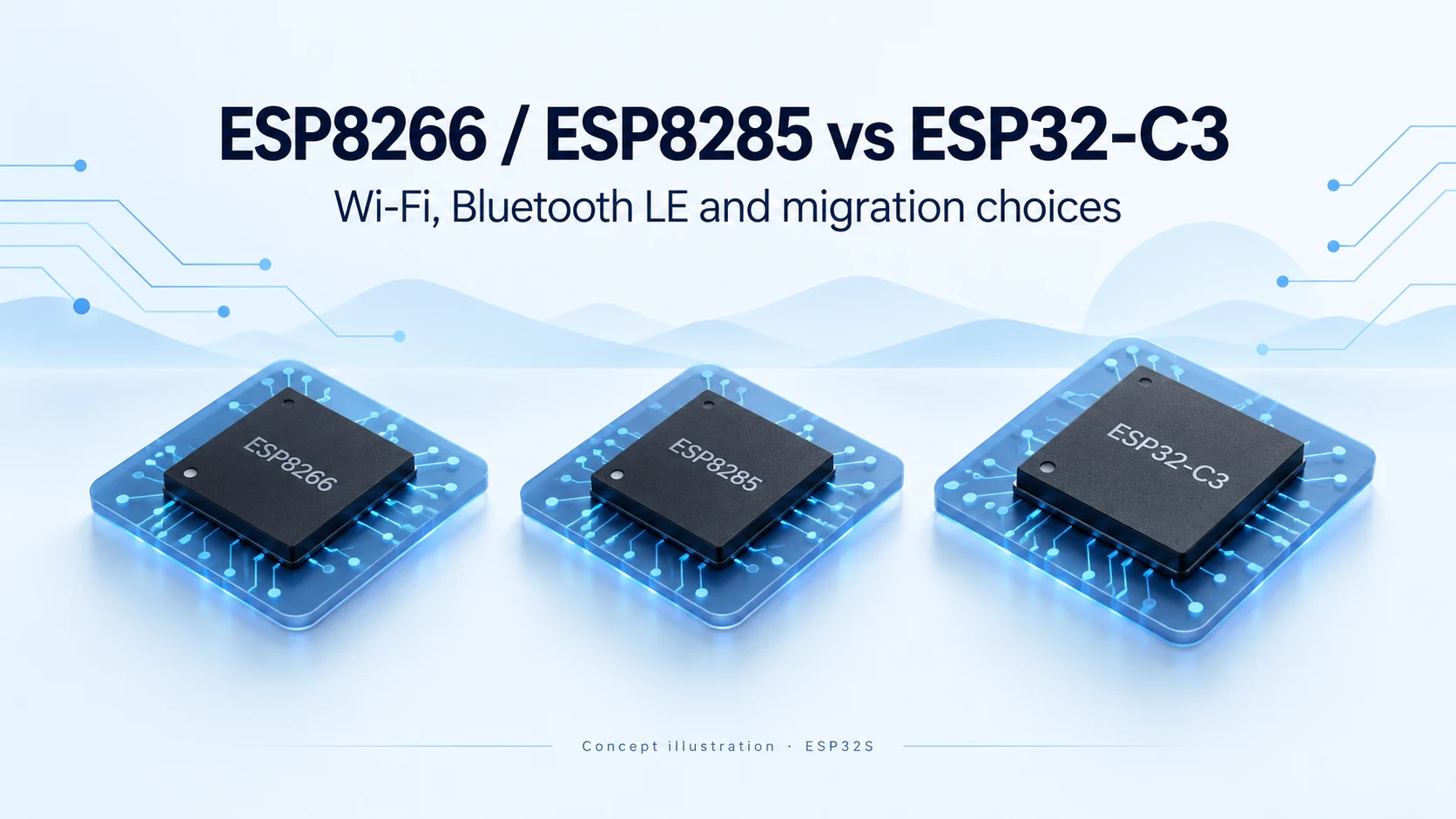
ESP8266 and ESP8285 helped make compact Wi-Fi products accessible. ESP32-C3 adds a different processor architecture, Bluetooth LE and a stronger hardware security foundation. Choosing between them is as much about the product lifecycle and migration effort as it is about specifications.
Reviewed October 15, 2026. This article compares official documentation and practical design considerations; it is not a measured speed, range or battery-life benchmark.
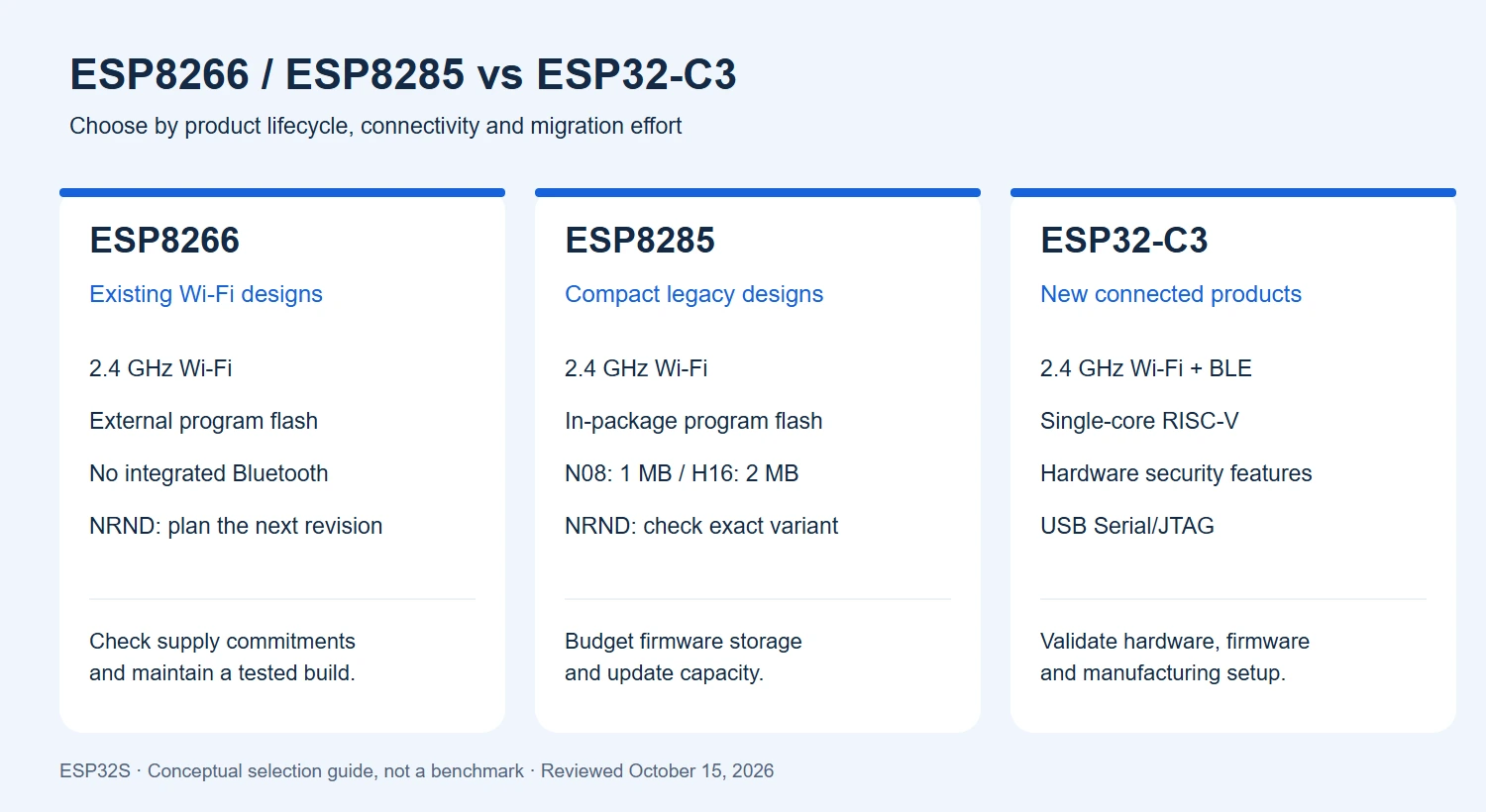
For a new connected product, our recommendation is to evaluate ESP32-C3 first among these three options, particularly when Bluetooth LE provisioning, firmware security or future software development matters. For an existing ESP8266 or ESP8285 product, compare the cost of continued maintenance with a properly tested migration.
Lifecycle matters: Espressif currently marks both ESP8266EX and ESP8285 as Not Recommended for New Designs (NRND). Their datasheet covers recommend ESP8684 as an upgraded model. That is Espressif’s stated alternative; our discussion of C3 is a separate engineering comparison. NRND alone does not mean that every existing product has stopped working or that every part is immediately unavailable. Check the exact ordering code and supply commitments before production. Sources: ESP8266EX datasheet v7.1 and ESP8285 datasheet v2.6.
| Feature | ESP8266EX | ESP8285 | ESP32-C3 |
|---|---|---|---|
| Processor | Single-core Tensilica L106 | Single-core Tensilica L106 | Single-core 32-bit RISC-V |
| Maximum CPU clock | 160 MHz | 160 MHz | 160 MHz |
| Wi-Fi | 2.4 GHz 802.11 b/g/n | 2.4 GHz 802.11 b/g/n | 2.4 GHz 802.11 b/g/n |
| Bluetooth | None integrated | None integrated | Bluetooth 5 LE; no Classic |
| Program flash | External SPI flash | In-package flash: N08 1 MB; H16 2 MB | In-package or external flash, depending on the variant |
| Native USB | No USB controller | No USB controller | USB Serial/JTAG; not general-purpose USB OTG |
| Design status reviewed | NRND | NRND | Evaluate the exact chip/module for the project |
Sources: ESP8266EX datasheet, ESP8285 datasheet and ESP32-C3 datasheet. Equal maximum clock speeds do not establish equal application performance. None of these three provides 5 GHz Wi-Fi, Wi-Fi 6 or an integrated Thread/Zigbee radio.
ESP8266EX uses external program flash. ESP8285 brings flash into the package, which can simplify a compact board layout. Do not assume every ESP8285 has the same capacity: the official family table lists ESP8285N08 with 1 MB and ESP8285H16 with 2 MB. Flash capacity affects firmware size, filesystem allocation and the room available for an update strategy.
For a product already built around either device, begin with its actual schematic, flash layout and firmware build. A label on a development board does not tell you how much memory your application can use. Flash stores code and assets; RAM holds runtime data. Treat them as separate budgets, and measure available heap while the network connection and the intended workload are active.
Espressif specifies a single RISC-V core at up to 160 MHz, 400 KB of internal RAM, and integrated Wi-Fi plus Bluetooth 5 LE. C3 also provides hardware security features including secure boot, flash encryption, HMAC and a digital signature peripheral. It is supported by ESP-IDF. See the official ESP32-C3 overview.
In a practical product, Bluetooth LE can provide a local configuration path while Wi-Fi handles the network connection. That is an application you implement and test, not an automatic behavior of the chip. Similarly, security hardware only helps when the firmware, key handling and manufacturing process configure it correctly. Plan how devices are provisioned, updated and recovered before enabling irreversible production settings.
The C3’s USB Serial/JTAG controller can support flashing, console and debugging on hardware that routes the appropriate signals. It is not a general-purpose USB host/device controller for arbitrary peripherals. Check the exact board schematic: a USB connector might instead connect to a separate USB-to-UART bridge. The C3 datasheet identifies the controller and its pin functions.
No—treat it as a migration project. Processor architecture, firmware images, pin assignments, boot configuration and peripheral behavior differ. Reusing application logic does not make an ESP8266 binary executable on a C3. Even similarly sized modules need an explicit footprint and signal comparison.
A datasheet sleep-current number is not a complete battery-life estimate. Include regulator quiescent current, LEDs, sensors, wake frequency, connection time and retransmissions. Measure charge consumed over a representative operating cycle, then estimate battery life using a realistic usable battery capacity.
For cost, compare the complete design and its production volume rather than a single advertised chip price. Module choice, external components, PCB area, firmware work, test fixtures and maintenance can change the result. We have deliberately avoided a universal price ranking or an untested claim that one device always delivers longer range.
If your project needs a more demanding display or camera pipeline, read our ESP32-S31 vs ESP32-P4 vs ESP32-S3 comparison. For practical setup, visit the ESP32S Wiki and firmware flashing guide.
Moving an existing Wi-Fi product to a custom C3 board? Our PCB design service can support the hardware work. Contact ESP32S to discuss firmware migration, custom firmware development and production flashing.
Documentation checked October 15, 2026. Recommendations are editorial engineering guidance. Images are original conceptual illustrations and a selection diagram; no comparative hardware benchmark was performed.


Choose an e-paper display for your ESP32 project: compare screen types, raw panels and modules, refresh modes, memory needs and power considerations.
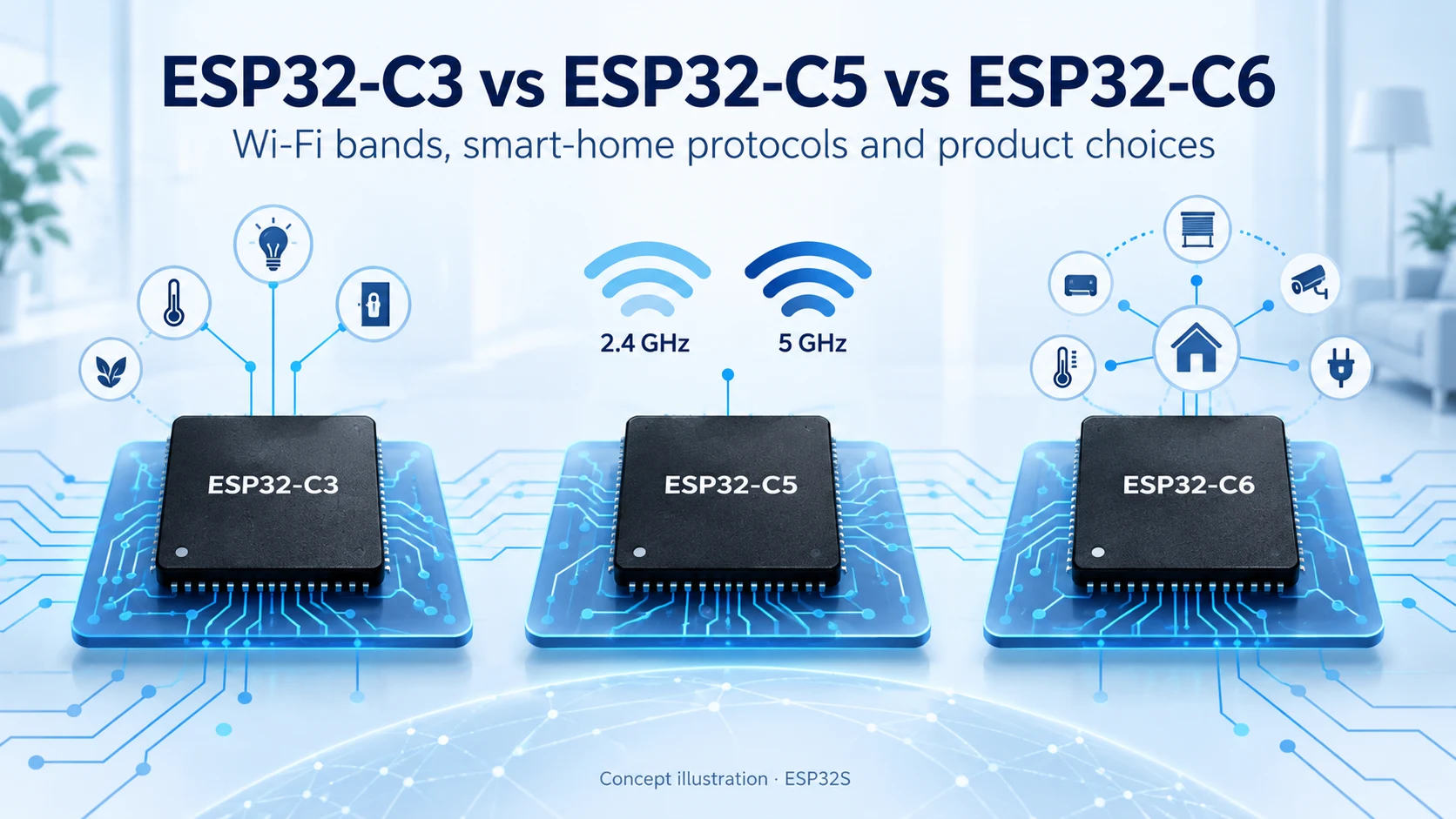
Compare ESP32-C3, ESP32-C5 and ESP32-C6 for Wi-Fi bands, Bluetooth LE, Thread, Zigbee, memory and Matter product design. Find the right connectivity for your project.
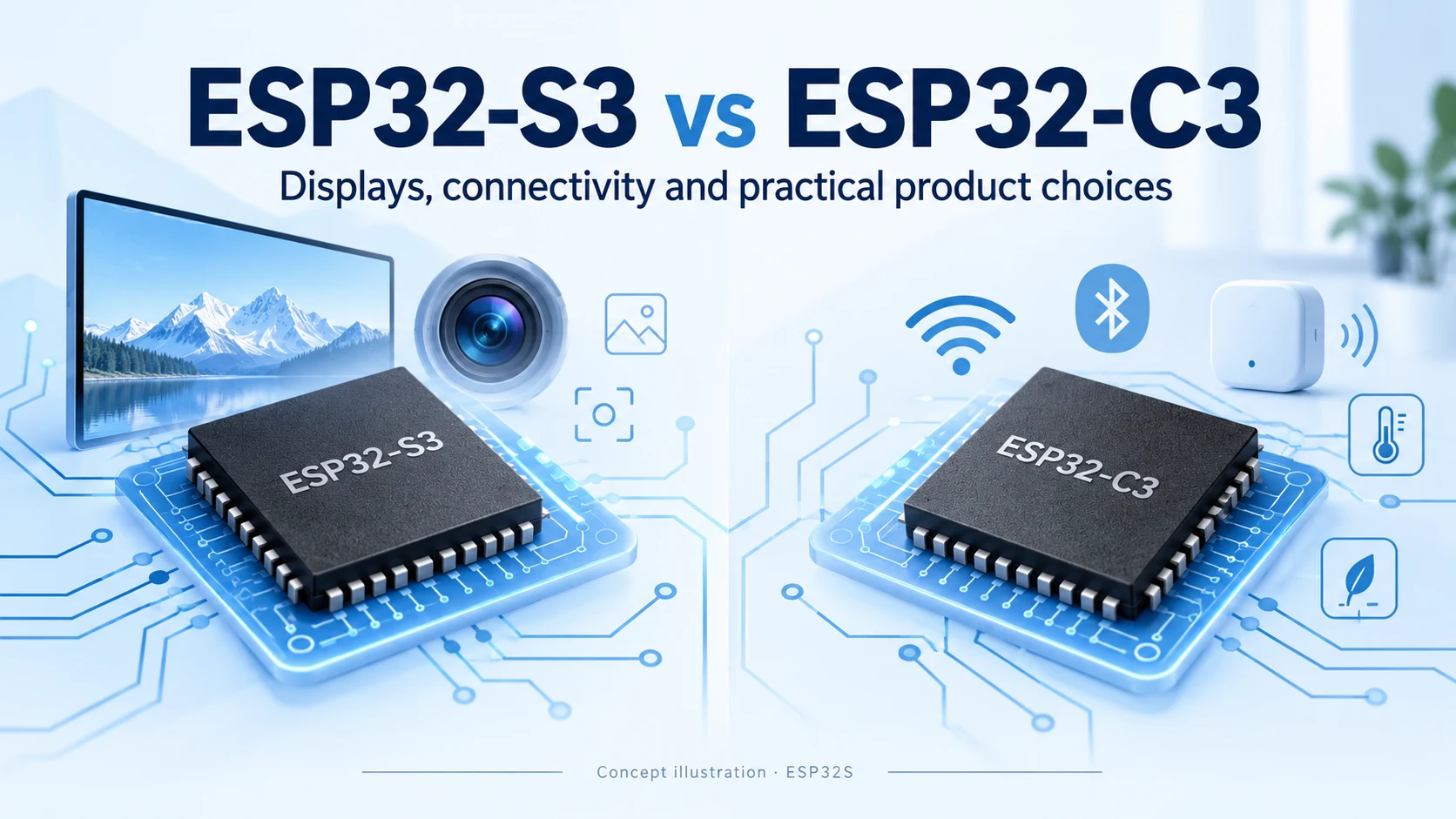
Compare ESP32-S3 and ESP32-C3 for CPU, memory, displays, cameras, USB and wireless connectivity. Practical advice for choosing your next connected product platform.
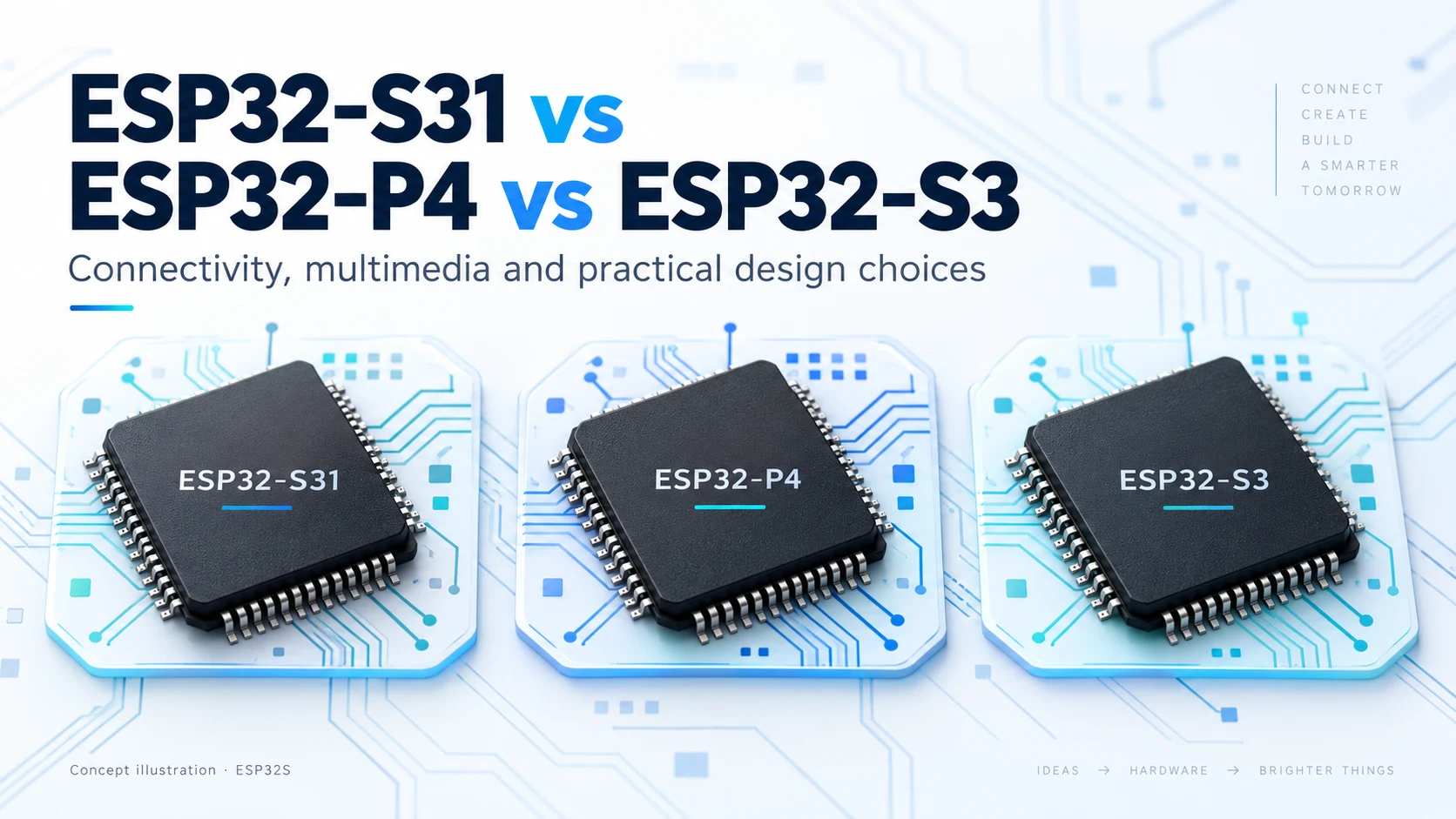
Compare ESP32-S31, ESP32-P4 and ESP32-S3 for connectivity, displays, cameras and memory planning. Learn the key hardware differences and practical selection criteria.
Most people meet us through the store. They buy an ESP32-C3 Supermini board or a camera module, it ships, and
Every ESP32 product starts on a dev board. That is the right way to start — you get a working
No account yet?
Create an Account